Your controls package has a budget. It has no author.
· Reading time 8 min · By Patrick Savioz
The right specification, at the right time, by the right person: the owner states its needs, an independent controls engineer writes the specification with the owner at preliminary design, and bidders respond on a comparable basis.
At home, you have a thermostat. Maybe a timer for the blinds.
In an office building, a school or a care home, there is the equivalent of several thousand thermostats, timers and switches. They are not on the wall: they are in a computer that makes decisions every minute. When the ventilation starts. At what temperature the water goes to the radiators. Whether the blinds come down. When the chiller switches on.
This system accounts for a significant share of a building’s technical budget, and it determines an even larger share of its energy bill over the following thirty years.
In most projects, nobody has written down what it is supposed to do.
It is not a scandal, not negligence, not a breakdown. It is the default. And since nothing breaks, nobody goes back to it.
The word you will see on your quotes
In the trade, this system is called MCR in French-speaking Switzerland and MSR in German (measurement, control, regulation), or the BMS, for building management system. Remember “BMS”: it is the word that will appear on your quotes and in your maintenance contracts.
You do not need to know more to read on. Just remember this: the BMS is not a machine. It is software, written specifically for your building, that runs all the machines.
And software is either specified beforehand, or put up with afterwards.
The budget exists. The Swiss cost code is even very precise.
Contrary to what is often believed, this item is not forgotten in budgets.
The Swiss construction cost code (BKP/CFC), the one your architect and your property manager use to structure a final account, gives it a dedicated position, 248, under the heading “building automation”. And it does not stop there: it distinguishes the supervisory computer, the controllers, the sensors and valves, the room controls, and the network that links it all.
The more recent code, the one used precisely to estimate costs at the start of a project, goes even further. The eBKP-H devotes a whole group of seven elements to building automation. The seventh is called:
“System integration”.
In other words, the idea that heating, ventilation, cooling, electrical systems and meters must talk to each other and report to a single screen is a cost item named in a Swiss standard. It has a position, it can carry an amount, it is designed to be priced.
Ask the question at your next project meeting: who has written down what is expected from that item?
In most project files, the honest answer is: nobody. The amount, on the other hand, is often there.
The regulation that made it a profession was archived in 2001
Thirty years ago, controls were an accessory to the boiler. They came with it, set up by the supplier. Leaving the subject to the heating and ventilation engineer was the right organisation at the time. It was even the only one that made sense.
A little-known Swiss detail shows the shift clearly. The SIA, the Swiss Society of Engineers and Architects, had published in 1992 a regulation dedicated to the services and fees of that profession: controls engineering and building automation. It remained valid until 31 July 2001, then was archived and merged into the general regulation for building services engineers. The subject no longer appears in the title.
The regulation that made the BMS a mandate in its own right, with its own fees, therefore disappeared at the very moment the profession was becoming autonomous: communication buses, software, data, ownership of the code.
The item kept its works budget. It lost its engineering mandate.
On the left, what the Swiss cost code provides; on the right, what the project file assigns. The budget stayed, the mandate disappeared.
The result today is that this specification is almost always written by the heating and ventilation engineer, on top of their own work, and that is one of the reasons why controls so often come last in the chain. An excellent ventilation engineer can size a flawless installation and, in the same file, describe the BMS by copying a supplier’s data sheet. It is not a lack of competence. It is a lack of mandate: they are asked for a document that no regulation describes any more, and that they are not paid for.
Both columns are needed. No question on the right is harder than those on the left: they simply belong to another profession.
What the absence of an author produces
Three offers that are not about the same building
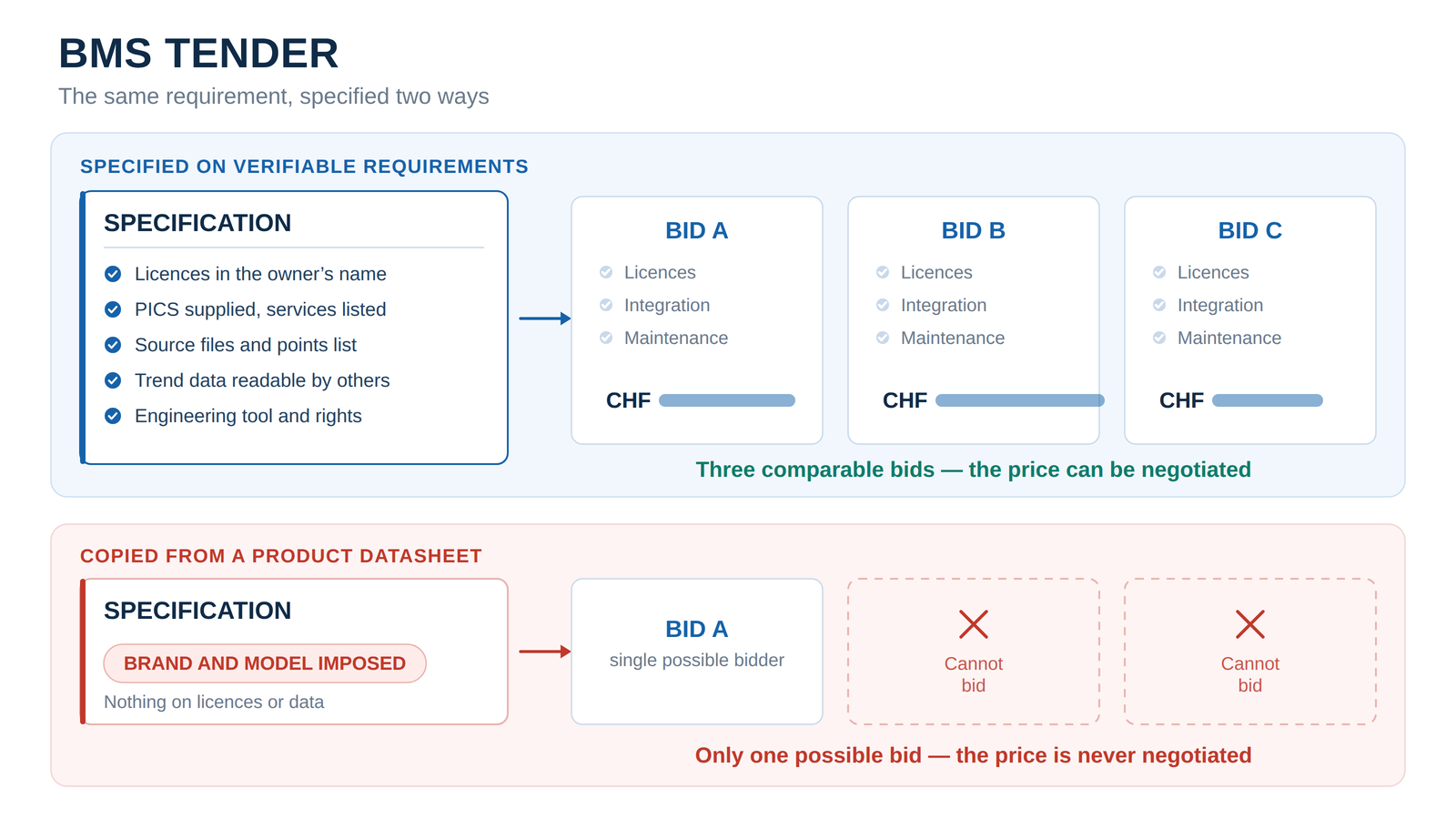
A tender for a BMS must contain a points list: the inventory of what the system will have to measure and control, room by room, machine by machine. In many files it is missing, and each bidder fills the gaps in their own way.
The three prices are then all correct, and none of them covers the same scope. Yet awarding to the lowest price assumes that the offers cover the same thing. Without a points list, that assumption is false: the price difference does not measure a service, it measures an interpretation, and the cheapest is often the one who assumed the least.
It happens, and more often than you might think. Nothing breaks. No alarm sounds. The occupants do not complain, since the temperature is right. The bill, however, pays twice.
Nobody sees it because nobody asked for the measuring points that would make it visible. A meter or sensor that was not requested at quotation stage costs several times its price two years later, if it can still be fitted. That is the mechanism of a poorly scoped BMS: almost nothing to install, and a bill every month.
Software paid for, and never received
The software that runs your building was written to measure. You paid for it: it is a line in the final account. But having paid does not mean having received. In most files, the owner holds neither the source files, nor the right to have them modified by another company, nor the software needed to open them.
It is like buying a house without receiving the plans. Everything works perfectly, until the day you want to knock through a wall, or simply get a second opinion. The full question is here: who really holds the keys to your building?
The four questions to ask
They require no technical knowledge. Ask them of your architect, your agent or your property manager, and listen to the quality of the answer as much as to the answer itself.
Who writes the BMS specification on this project, and is it their main profession?
Will the points list be attached to the tender? If not, on what basis will we compare the offers?
What will we receive at the end, in addition to an installation that works: the software files, the right to have them modified by a third party, the passwords?
How many different companies will be able to work on this system in ten years’ time?
A precise answer within a few days indicates a well-kept file. An evasive answer tells you where you stand, and it is better to know now.
The only moment when all this is free
This is the most important point in this article, and it fits in four lines.
Before the quotes, at design stage. Cost: nothing, a few pages of appendix.
After the contract award. A variation, negotiated from a weak position.
At commissioning. You discover what is missing. Too late to demand it.
In operation. A project, with a budget to be found.
It is the same request at all four moments. Only its price changes, and it changes a great deal.
And several cantons have gone further: they require this package to be entrusted to a specialist engineer, separate from the one who sizes the heating and ventilation.
A final remark
Nothing in all of the above looks like a breakdown.
The budget is complete. The design work was carried out properly. The engineer did serious work in their field. The tender went well, the installation works, maintenance is in place, and the supervision screen shows no alarm.
That is precisely what makes this problem costly: it does not show up anywhere. You only discover it the day you want to do something: add a zone, understand a bill, change provider. And then you realise that you cannot.
So the question to ask at the start of a project is not “who installs the controls?”. It is “who specifies them?”.
The Swiss documents cited, if you want to check
Swiss construction cost code (BKP/CFC), position 248 “Building automation”, published by CRB.
Element-based construction cost code, eBKP-H (SN 506 511), group D02 “Building automation”, elements D02.01 to D02.07, including D02.07 “System integration” (CRB and SIA).
SIA regulation 108/1 (1992) on services and fees for controls engineering and building automation, valid until 31 July 2001, now archived.
SIA regulation 108 currently in force, services and fees of engineers specialising in building services, mechanical and electrical engineering, at shop.sia.ch.
SIA standard 386.110, impact of building automation, controls and building management on the energy performance of buildings.
KBOB recommendation on the use of the BACnet standard and its application guide, published by the Coordination Conference for Public Sector Construction and Property Services, in French and German, free to download.
Technical HVAC and electrical recommendations of the Canton of Vaud; “Gebäudeautomation” directive of Immobilien Aargau.
A project where the controls package needs to be specified before the tender, not during it? That is exactly the role of our owner’s representation. On a building already in operation, the controls and BMS audit tells you what was specified, and what was not.