There is a moment in a ventilation retrofit project when a good savings calculation turns into an argument against you. That moment arrives when you apply for a subsidy.
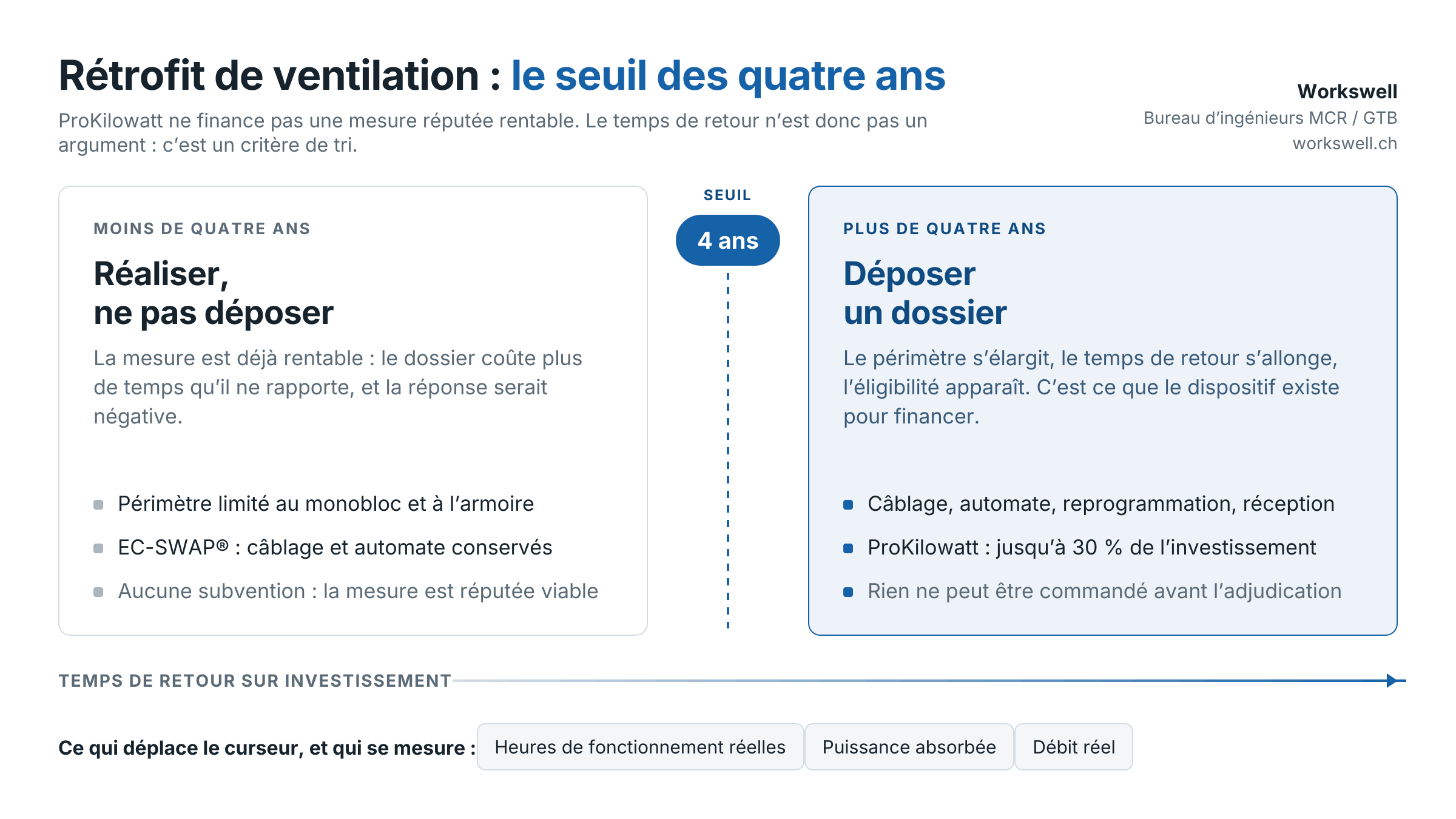
ProKilowatt, the Swiss federal competitive tendering scheme, covers up to 30 % of the investment cost of an electrical efficiency measure. But it only funds what would not happen without it. A measure with a payback period below four years is deemed economically viable, and it is not supported. If your retrofit pays back in three years, the answer is no, and it is a reasoned no.
That is not bad news. It is a sorting criterion, and it tells you which route you are on.
What the scheme funds
The competitive calls for tenders are now in their seventeenth edition. They are financed by the grid surcharge and have an annual envelope of up to CHF 70 million. For the 2026 call, the announced split is a maximum of CHF 40 million for projects and CHF 30 million for programmes.
The mechanism is a competitive tender, and that is what sets it apart from a conventional grant fund. You set the contribution you request yourself. Applications are then ranked by their cost-effectiveness ratio, that is, the contribution requested divided by the electricity savings generated, expressed in centimes per kilowatt hour. The less you ask for and the more you save, the better you rank. The usual ceiling is 8 ct./kWh, and the effective average sits well below it: the 2025 round came in at 2.9 ct./kWh including administration costs, with 63 projects and 3 programmes supported, CHF 26 million committed and around 53 GWh of annual savings.
The published success rate is high: roughly 85 % of admissible project applications receive a contribution. That figure deserves to be read correctly. It does not say the scheme is generous; it says that the applications which fail, fail before the competitive stage, on the eligibility conditions.
Two doors, separated by an investment threshold
There are two routes, and confusing them wastes time.
The programme. A third party, often a trade association or an engineering firm, runs a thematic programme funded by ProKilowatt; companies then enrol for standardised, technically simple measures whose investment costs stay below CHF 300,000. Two existing programmes bear directly on our subject: ProELA, for the renovation and optimisation of ventilation installations, and SPEED, for the replacement and optimisation of electrical drives. Enrolling in a running programme is by far the simplest route.
The project. As soon as investment costs exceed CHF 70,000, the measure can be submitted as an individual project. The contribution requested runs from CHF 20,000 to CHF 6 million, capped at 30 % of the investment. Submission is online, at any date in the year, and a decision normally follows three to four weeks after a complete application. For the 2026 call, the project submission deadline is 1 November 2026; after that, the following round's conditions apply.
Submitting a programme is a different business: contributions run from CHF 150,000 to CHF 3 million, the annual deadline falls in spring, and the programme sponsor commits to recruiting and supporting participating companies over several years. That is not the route for an owner who wants to upgrade the ventilation of one building.
The rule that costs the most applications
Only measures that have not yet been implemented are supported. And implementation starts well before the site work: it includes the unconditional decision to proceed, the signing of contracts and the ordering of equipment. You therefore have to wait for the award decision before ordering anything.
On a ventilation installation, this rule has a blunt consequence. A motor that fails on a Tuesday morning is not a ProKilowatt case. The emergency replacement will be ordered the same day, and it will be ordered like for like, because that is what is in stock. The subsidy is only available for anticipated renewal, the kind you decide on while the installation is still running.
Second consequence: a rejected project cannot be resubmitted within the same call. You have one attempt per round. That argues for a prepared application, not one filed on the off chance.
The paradox of the ventilation retrofit
A ventilation drive often runs 4,000 to 6,000 hours a year, sometimes more. Fan power varies approximately with the cube of the airflow, which makes this the one item where a modest reduction produces the largest gain. On a constant-speed installation, a well-targeted retrofit is measured in tens of per cent of electricity saved.
Run the numbers and you will see the problem coming: these measures frequently land below four years. In the eyes of the scheme they are therefore economically viable, and not eligible.
The useful conclusion is this. If your retrofit pays back in two or three years, do not build an application: carry it out. The time spent asking for 30 % costs more than the 30 % brings in, and every heating season that passes consumes the equivalent of part of the subsidy you were hoping for.
The four-year threshold is crossed elsewhere, and that is where ProKilowatt becomes the right instrument again: when the real scope is not the motor. Reworking the wiring between the panel and the unit, replacing the controller, having the MCR software reprogrammed, running a new commissioning and a new acceptance: the investment multiplies, the payback lengthens, eligibility appears. That is the classic case of a complete air handling unit renovation.
These two routes are mutually exclusive, and you need to know which one you are on. Narrowing the scope makes the measure profitable and ineligible; widening it makes the measure eligible and slow. That is not an objection to the scheme; it is an exact description of what it is designed to encourage, namely the heavy renovations nobody launches spontaneously.
EC-SWAP®: staying on the right side of the threshold, deliberately
The reason a ventilation retrofit gets postponed was never the price of the motor. It is what has to be reopened around it: the wiring between the panel and the unit, the controller, the reprogramming of the MCR, a new commissioning, a new acceptance. The motor costs a few thousand francs; what surrounds it costs several times more and ties up the building. It is that additional cost which pushes the payback beyond four years, and therefore into subsidy territory.
EC-SWAP® is a patented solution that stops precisely short of that limit. It is a control converter: it takes the low-speed and high-speed supplies coming from the existing panel, feeds the EC motor with 400 V three-phase, generates the corresponding 0-10 V signal, and returns the fault contacts to the control system in place. The BMS loses no information. The wiring stays, the controller stays, the building's control logic is not reopened. It is the principle of a retrofit without touching the wiring, in industrialised form.
A 130 × 130 × 75 mm enclosure, IP65, 16 A, one module per air circuit. Control is by low-speed priority, by high-speed priority, by local adjustment on the LOW and HIGH potentiometers, by an external command on the logic port, or by a CO2 or VOC sensor in the extract air duct: a constant-speed installation then becomes demand-controlled ventilation, without changing the controller. Up to 70 % savings on the electricity consumption of the ventilation, depending on the configuration. The module is fitted by an electrician or by the HVAC installer: there is no control engineering to redo, and that is the whole point.
Set against the scheme described above, this produces a net effect that is better stated plainly: an intervention of this scope usually falls on the profitable side of the threshold, and therefore on the non-subsidisable side. We say so without hedging, because it is the intended result. A two-day site visit per unit that pays back in two or three years does not need to wait nine months for an award decision that would be negative anyway.
Two situations remain where the two logics meet:
- The portfolio, not the single unit. One module per air circuit, across ten or twenty circuits, comfortably crosses the CHF 70,000 of investment that opens the project route, and bundling several measures from the same owner is explicitly allowed. The payback, however, barely changes: so it is eligibility, not the amount, that needs checking first.
- The unit at end of life. When the air handling unit has to be replaced anyway, the control converter no longer has a purpose and a ProKilowatt application becomes the right instrument again. There is no point defending a retrofit where a renovation is due.
One point to check in both cases, tables in hand rather than on principle: the eligibility criteria set minimum efficiency requirements on the motor and its control electronics. A current-generation EC motor sits comfortably above them, but that is demonstrated with a datasheet, not with a sales argument.
The payback is calculated on figures nobody has
Everything above turns on one number: the payback period. And in a ventilation file, that number almost always rests on three false assumptions.
Nameplate power stands in for absorbed power. The theoretical time schedule stands in for actual operating hours. The airflow from the acceptance file stands in for today's airflow, ten years, two filters and a modified duct network later. The three errors do not point the same way, and their combination can just as easily overstate the saving by half as halve it.
The consequences are symmetrical and costly. Overstating the saving produces a flattering cost-effectiveness ratio, a good ranking, and then a problem at verification, which is carried out on supporting documents and may extend to actual measurement. Understating it leads to dropping a project that would have cleared the threshold.
One calculation detail is worth knowing, because it bears directly on the ranking: savings are counted over a standard useful life. It is 15 years for most equipment and installations. The more favourable 25 years is reserved for replacing a motor on its own, and does not apply to a motor forming an integral part of an installation, which is precisely the case of a fan. A ventilation retrofit is therefore calculated over 15 years.
There is only one way out of assumption: measure. A supervision system already logging absorbed power, running hours and speed states makes the exercise almost free. Failing that, a measurement campaign of a few weeks before the works beats a figure to be defended later. Incidentally, the same survey will say whether demand-controlled operation makes sense on this installation, and it is the ordinary content of a control system audit.
ProKilowatt or your electricity supplier, not both
Since 2026, a second federal instrument has targeted the same potential: efficiency gains by electricity suppliers, which assign every distributor above a certain size a quantified savings target to be achieved among its end consumers. Ventilation and drives appear there too, under standardised measures.
The two schemes are mutually exclusive. A measure supported by ProKilowatt must not receive other public aid and, conversely, measures supported by the Confederation, a canton or a municipality cannot be counted by an electricity supplier. The ProKilowatt conditions devote a chapter to this delimitation. The choice is made before the order, and it cannot be remade.
The two routes do not, however, set the same conditions, and the asymmetry is interesting. Reading its directive, the electricity supplier instrument sets no payback threshold: it requires the best available technology, a saving established by measurement or by well-founded calculation, a durable effect, and disposal of the old equipment. In other words, the retrofit that is too profitable for ProKilowatt is not necessarily out of the running elsewhere.
We have not yet handled an application under this second scheme, and this article does not describe established eligibility: it describes two frameworks and the criterion that separates them.
What to do, in order
- Order nothing and sign no contract before the financing question is settled. It is the only irreversible step on this list.
- Establish the payback on measured figures: actual operating hours, absorbed power, airflow. That number decides the route, and nothing else does.
- Under four years, carry it out. Above, check whether a running programme covers the measure before considering an individual project: enrolling in a programme is quicker than an application.
- Ask your electricity supplier before choosing: does it have an efficiency gains target, and does it support ventilation measures? The two arrangements cannot be combined.
- Look at the calendar. Projects in the 2026 round are submitted up to 1 November 2026. An application prepared in October for summer site work follows a reasonable rhythm; one improvised at the end of October does not.
The full conditions and the quick calculation tool are published on prokw.ch. They are worth reading: the scheme is more legible than its reputation.
What we do
We survey your ventilation installations, we measure what needs measuring, and we produce the payback period and the annual savings on figures that hold up. That is what decides the financing route, and it is what a subsidy application, like a savings protocol, requires you to demonstrate.
Workswell is an engineering firm, and does not do integration. We do not install equipment, we do not programme your controller and we represent no brand: implementation is for the installer or integrator of your choice. Our “Supervision & Integration BMS” page uses the word in the sense of systems integration: specifying interfaces, commissioning and bringing plant onto the supervision system, not installation or programming. We audit, specify, commission and remotely manage installations we did not build. On a subsidy application, that position has a direct advantage: the payback we calculate does not depend on the order that would follow.
Send us the motor nameplate, your control schematic and the time schedule of the installation. We will tell you what the retrofit represents in kWh per year, which side of the four years it falls on, and which door that opens.
Get in touch