In a condominium building, an air handling unit was running at 2 kW day and night, with no night setback. No alarm had gone off, and for good reason: nothing was broken. A fan running at night is in operation, not in fault.
It was the sub-metering of the common areas that revealed it, by separating the ventilation from the rest of the shared services. Since the maintenance call-out, the ventilation uses up to 25 kWh less per day.
What nobody knows is how long it had been running like that. That is the real question for energy monitoring: not how much you save once the drift is found, but how long it runs before anyone sees it.
An alarm watches a state, not a consumption
A BMS raises alarms on faults: a motor that trips, a sensor out of range, a frost risk, a clogged filter. It says nothing about an installation that works normally at the wrong time. Heating that no longer switches to setback, a circulation pump that runs all summer, car park lighting left on around the clock: none of these is a fault, and none triggers an alarm.
Even the clogged filter, which has its own alarm, can go unnoticed: on a variable-airflow system, a fixed-threshold pressure switch becomes blind or oversensitive. And in many buildings, the common areas have no BMS at all: only the distribution network operator’s meter.
Monitoring watches something else: the gap between what a meter consumes and what it should consume, at that hour, on that day. That is what lets it see what no alarm sees.
The case: the common areas of a condominium building
| Parameter | Value |
|---|
| Building | Condominium, common areas |
| Measurement | Sub-metering separating the ventilation from the rest of the shared services |
| Finding | Air handling unit at 2 kW day and night, no night setback |
| Ventilation consumption before | 2 kW × 24 h = 48 kWh per day |
| Saving recorded after the call-out | Up to 25 kWh per day |
| Annual equivalent | 25 × 365 = 9,125 kWh per year |
The finding and the saving were measured; the details are in our field report.
From here on, we take 25 kWh per day and assume the drift started on an arbitrary day. Only one thing changes from one scenario to the next: the way it is discovered. The delays that follow are working assumptions.
Four ways to discover the same drift
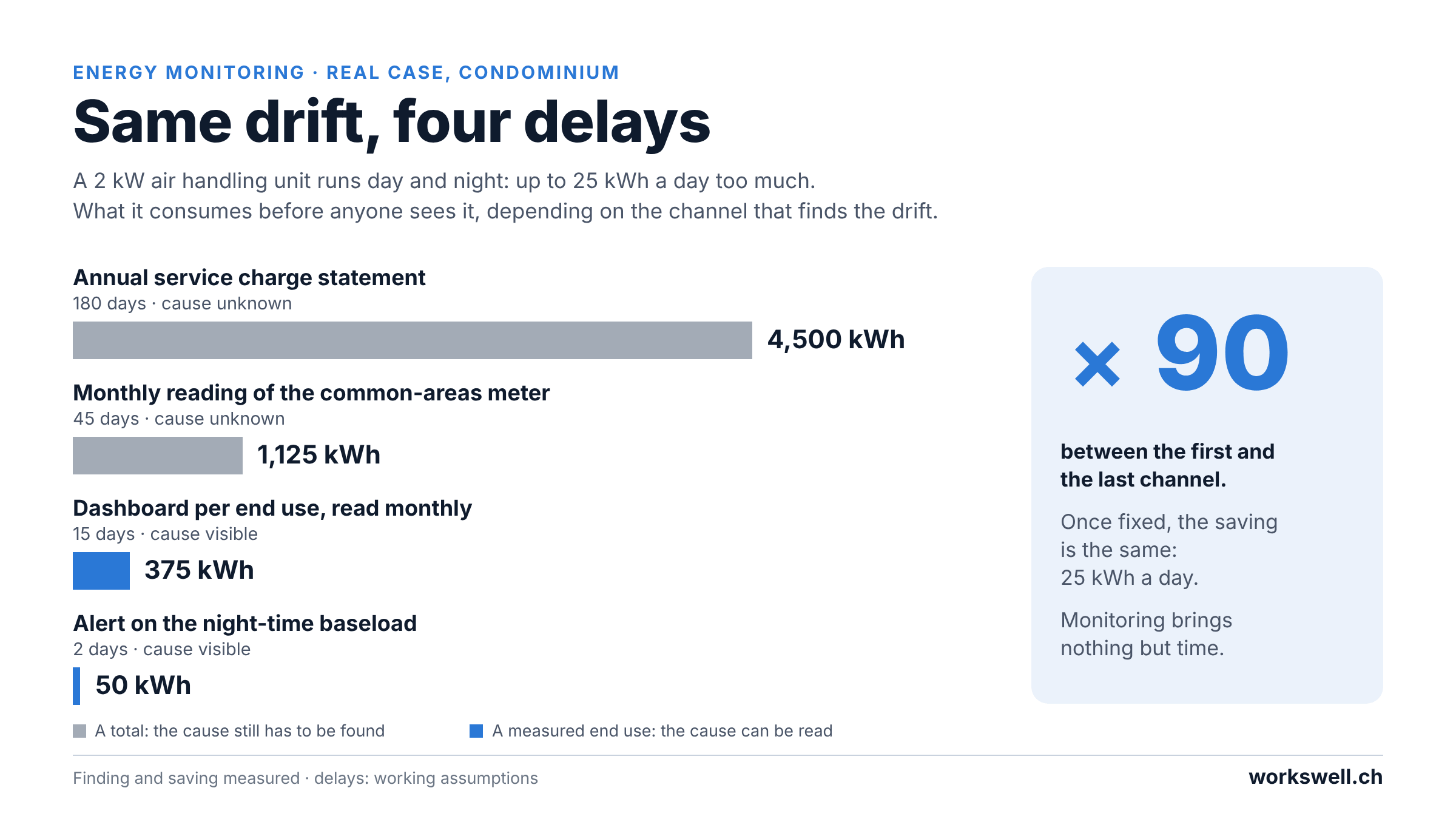
The annual service charge statement. In a condominium, the common areas’ electricity appears once a year in the service charge statement, as a total in francs. A drift that starts at any point in the accounting year runs on average six months before the books close: 180 × 25 = 4,500 kWh. The statement does not say where the difference comes from, and a tariff change can be enough to hide it.
The monthly reading of the common-areas meter. The drift adds 25 × 30 = 750 kWh per month. It shows up if someone compares the readings and nothing else has changed in the meantime. We take 45 days: the month already under way, then one full month to confirm. That is 45 × 25 = 1,125 kWh, and still no cause: this meter adds up ventilation, lighting, lift and pumps.
A dashboard per end use, read every month. With sub-metering, the ventilation curve shows a night that no longer drops. The cause is visible at a glance. The delay depends on how often it is read: 15 days on average for a monthly reading, so 15 × 25 = 375 kWh.
A drift alert on the night-time baseload. Every night, the monitoring compares the ventilation’s consumption with its reference. Two nights above the threshold, and the alert goes out: 2 × 25 = 50 kWh.
Comparison
| Detection channel | What it shows | Assumed delay | Excess consumed before detection | Cause visible |
|---|
| Annual service charge statement | An annual total in francs | 180 days | 4,500 kWh | No |
| Monthly reading of the common-areas meter | A monthly total | 45 days | 1,125 kWh | No |
| Dashboard per end use, read every month | The curve of each end use | 15 days | 375 kWh | Yes |
| Alert on the night-time baseload | A deviation from the reference | 2 days | 50 kWh | Yes |
Same drift, same saving once fixed. Between the first and the last row, a factor of 90.
The monitoring did not save a single kilowatt-hour
In all four scenarios, the saving after the fix is the same: 25 kWh per day. It comes from the call-out, not from the monitoring. Monitoring does not set a schedule or change a filter. What it brings is time: it shortens the interval between the start of a drift and its correction.
Three consequences follow.
Monitoring that nobody reads is an annual statement with nicer charts. Its value lies in the reference, in the alert and in the person who receives it, not in the dashboard.
Its value repeats. A corrected drift can come back silently: a manual override forgotten after a repair, a schedule changed during a call-out, filters that clog up again. Each return restarts the clock. Checking over time that a fix holds is exactly what tracking a performance commitment means.
It is useful before the works. To claim a saving, you need a reference consumption recorded before the intervention. In an EffEl file, that consumption is measured before the works and cannot be made up afterwards. Monitoring that is already in place has it, without improvising a measurement campaign.
What corrects the calculation
- The delays are assumptions. In the real case, nobody knows how long the unit had been running like that: the drift may have lasted months, even years. That is not a weakness of the calculation; it is its argument.
- The reference decides everything. Comparing with the previous month invents drifts that are not drifts, because the season changes, and hides others. For ventilation, the reference is the night-time baseload and the expected schedule. For heating, the energy signature: consumption as a function of outdoor temperature. For an annual review, the same period the previous year.
- An alert is only as good as its recipient. Who receives it, who acts, and within what time: caretaker, property manager or maintenance company. Too many alerts, and nobody reads them any more: thresholds are set over a few weeks of normal operation.
- A wrong measurement drifts too. A current transformer fitted the wrong way round, a forgotten transformation ratio or a wrong pulse constant distort monitoring for years. The sum of the sub-meters is compared with the main meter before the data is used (see data acquisition).
- Billing is metrology. As soon as the readings are used for billing, in a self-consumption community (ZEV), or to recharge service costs, the meters fall under legal metrology (Measuring Instruments Ordinance, METAS).
Five questions to ask before signing up for monitoring
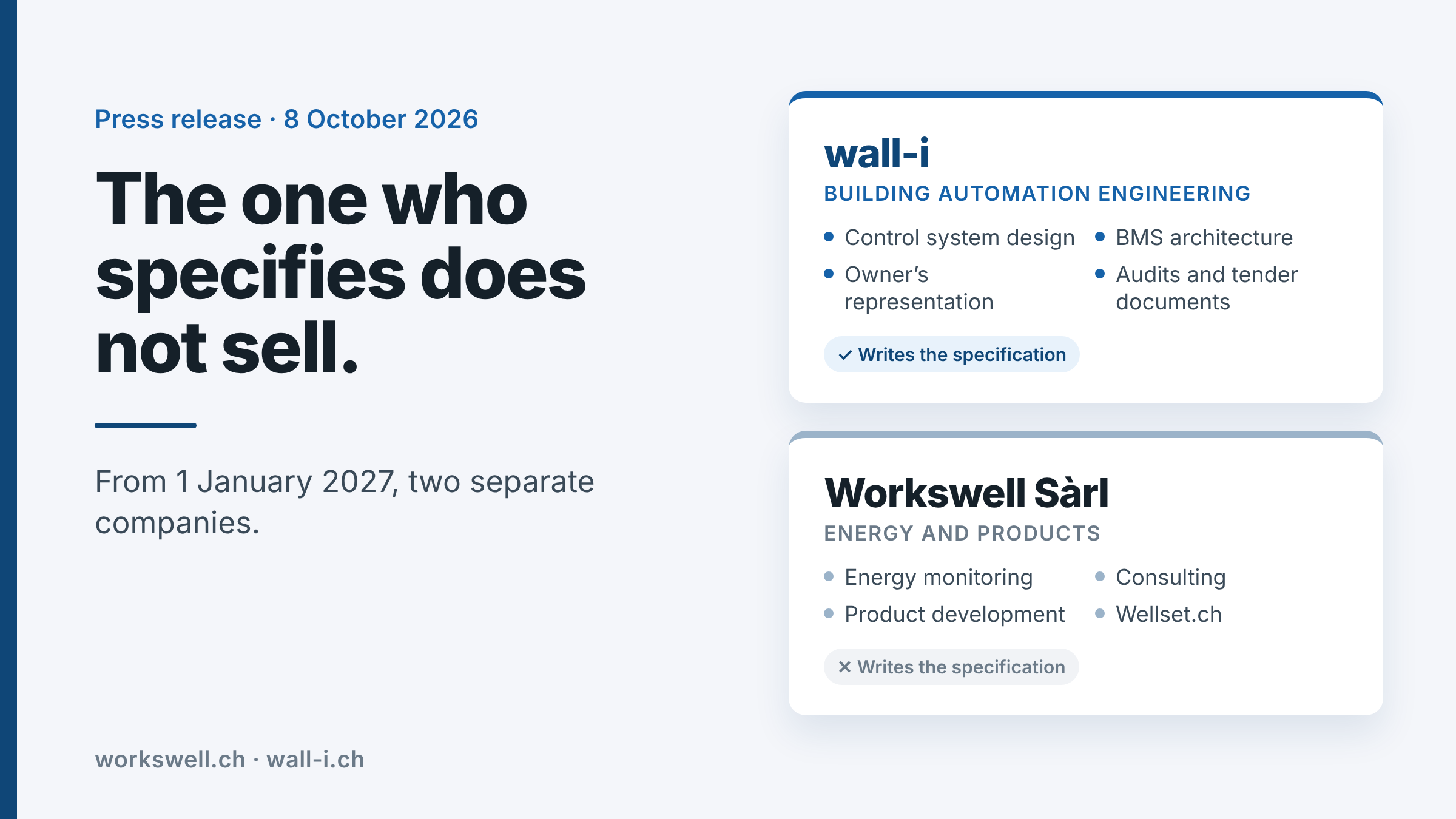
Workswell sells monitoring services: read this list with that caveat in mind. It applies to any provider, including us.
- Which end uses are separated? A main meter gives a total. At a minimum, the end uses that run at night must be separated: ventilation, heating or cooling production, pumps.
- What reference is each meter compared with? Night-time baseload, schedule, energy signature, previous year: one reference per meter, in writing.
- Who receives the alert, and who acts? A name, a deadline, a threshold. Without them, monitoring goes back to being a statement.
- Can the data be exported? Open protocols, export in an open format, a documented metering plan (location, quantity, unit, address and factor of each point). You must be able to change tool or provider without losing your history.
- How long is the history kept? Long enough to serve as a reference before works, and then to check that they deliver what they promised.
Frequently asked questions
Do you need a BMS to set up monitoring?
No. Meters are read directly over M-Bus, Modbus or BACnet, and split-core current transformers allow electrical sub-metering without disconnecting a circuit. If there is a BMS, its meters and trend logs are reused rather than duplicated.
What is the difference between a BMS and energy monitoring?
A BMS controls the installations and raises alarms on their faults. Monitoring measures consumption and compares it with a reference. The first tells you whether an installation works; the second, whether it consumes what it should.
How long should you measure before works?
Over a representative period: working days, nights and weekends. A few weeks are often enough for a baseload or a schedule. An energy signature needs a range of outdoor temperatures, so usually one heating season.
Does monitoring make sense for a small condominium?
Yes, if it measures where the consumption is. In the case in this article, separating the ventilation from the rest of the shared services was enough to reveal the drift.