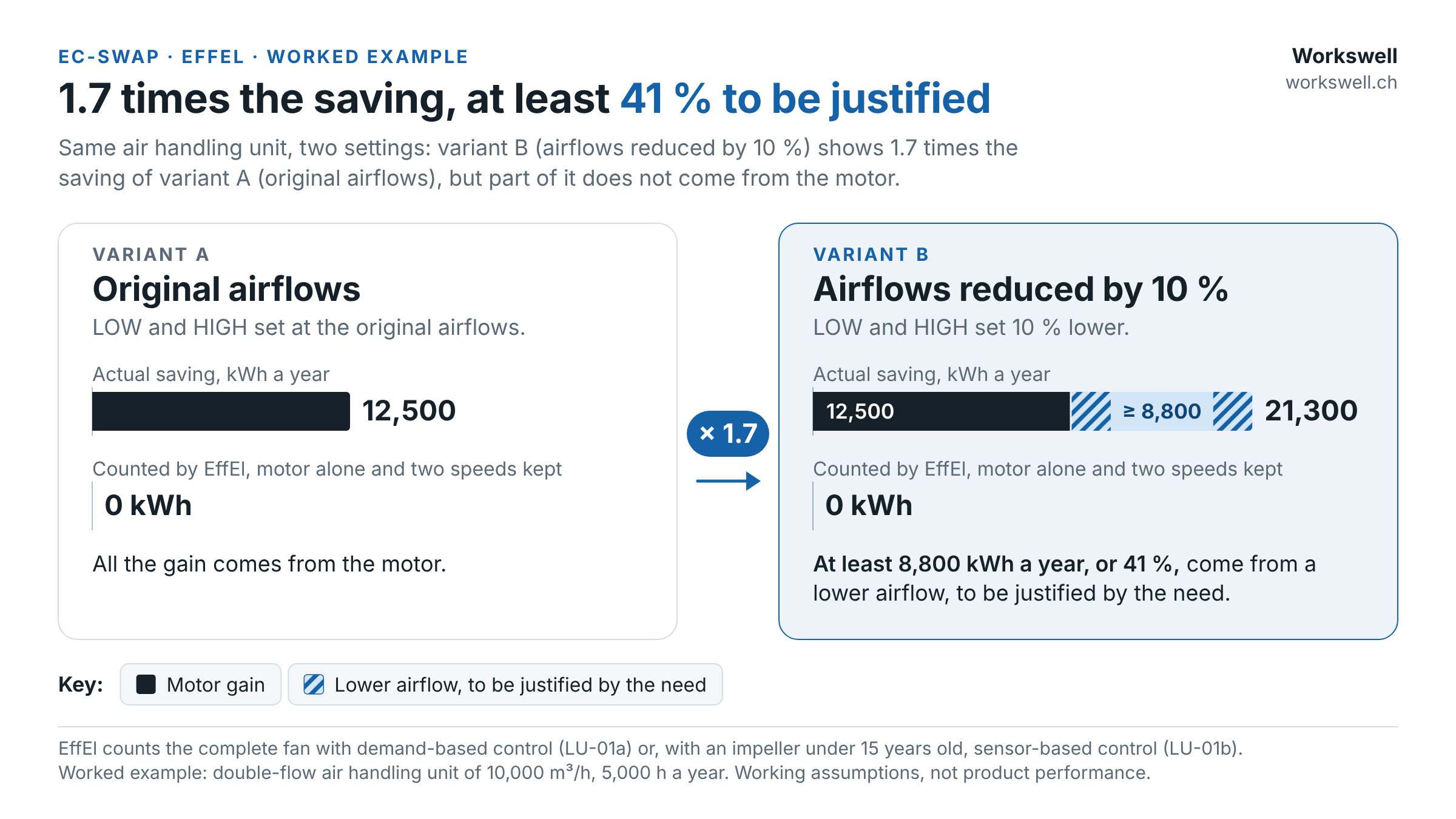
In this article’s worked example, one potentiometer setting at commissioning is enough to take the saving of an air handling unit converted to EC from 12,500 to 21,300 kWh a year. Those two figures are not worth the same.
The first comes entirely from the motor. The second is at least 41 % lower airflow: a reduced service, to be justified by the need.
And for EffEl, neither counts as it stands. The EffEl office has clarified this with the SFOE: with two speeds kept, the motor change is not counted, and a complete new fan does not fall under LU01a either. What counts is the move to demand-based control, for example with a sensor: with a complete fan, motor and impeller (LU01a), or, if the impeller is less than 15 years old, with the motor alone (LU01b).
EC-SWAP is a product of Wellset, Workswell’s product brand. We sell it: read this article with that caveat. The figures are calculation assumptions, not product performance, and the text describes what a file must contain, not an accepted file.
Status as of 6 November 2026. The first versions of this article (in French) cited measure MO01a and counted the gain from the motor alone under EffEl; the version of 5 November left open the question of a complete fan keeping two speeds. The EffEl office clarified the rules on 23 and 27 October and on 5 and 6 November 2026, after consulting the SFOE; they are reflected below.
The article first recalls how EffEl counts a saving, then follows a two-speed air handling unit in site order: before the works, at commissioning, after the works.
EffEl in brief
EffEl is the Swiss programme of efficiency improvements by electricity suppliers. It is an obligation, not a subsidy: Art. 46b of the Energy Act (EnA) requires suppliers to achieve electricity savings each year among end consumers in Switzerland. For those whose reference sales volume reaches 10 GWh, the annual target is 1.0 % in 2026, 1.5 % in 2027 and 2.0 % from 2028.
Four rules are enough to follow the rest:
- The supplier reports and remains responsible. An engineering firm or an installer can plan and carry out the measure, but it is the supplier that reports it to the SFOE.
- Only electricity counts, for measures carried out since 1 January 2025.
- The saving counted is 0.75 × Ns × ΔEa. ΔEa is the annual saving, Ns the standard impact period that the SFOE sets for each measure. The 0.75 factor applies even to a saving measured at the meter.
- A measure is reported only once, using a standardised SFOE protocol. For ventilation there are two protocols: LU01a (replacement of the complete fan, motor and impeller, with demand-based control) and LU01b (motor alone, on a ventilation system less than 15 years old: only the move to demand-based control counts). MO01a does not apply to ventilation motors. A non-standardised application is possible only if no standardised measure covers the work: it is not a way round the conditions of LU01a or LU01b.
The details are in the SFOE directive (in French).
What EffEl counts with the EC-SWAP
The EffEl office replied in writing, most recently on 6 November 2026, with the SFOE’s position. The 15-year criterion applies to the ventilation system (impeller, transmission, drive), not to the air handling unit.
| Works | Age of the impeller | Measure | Period counted |
|---|
| EC-SWAP, motor alone, two speeds kept, same hours | Any | None | · |
| EC-SWAP, motor alone, two speeds, reduced operating hours | Less than 15 years | LU01b | 1 year |
| EC-SWAP-PRO, motor alone, airflow controlled by a sensor | Less than 15 years | LU01b | 4 years |
| Motor alone, whatever the control | 15 years or more | None, and no non-standardised measure | · |
| Complete fan replaced (motor and impeller), two speeds kept (EC-SWAP) | Any | None | · |
| Complete fan replaced (EC motor and impeller), air handling unit kept, airflow controlled by a sensor (EC-SWAP-PRO) | Any | LU01a | 15 years |
LU01a requires an IE4 motor, a fan meeting the SFOE’s minimum efficiency and a speed controlled according to demand. The SFOE clarified this on 6 November 2026: a two-speed control is not enough, even with an adapted time schedule, because the calculation assumes modulating, demand-based control, for example with a sensor. An EC motor with integrated electronics, on the other hand, is treated as equivalent to a motor fitted with a frequency converter. Under both protocols, the saving is calculated with the SFOE workbook, or by a detailed analysis above 20 kW or to claim a higher measured gain.
What the EC-SWAP does, and what it leaves in place
The EC-SWAP is a control converter for EC motors. It is installed inside the air handling unit, as close as possible to the fan: an IP65 enclosure measuring 130 × 130 × 75 mm. The existing cable of the two-speed motor connects to its input, the output feeds the EC motor and the module sends it a 0-10 V setpoint. Four points define the installation:
- The MCR controls are kept, with no reprogramming of the controller.
- Only the contactor wiring is adapted, in the electrical panel.
- One module per airflow: two for a double-flow air handling unit.
- Two potentiometers per module, LOW and HIGH, from 0 to 100 %, set at commissioning.
What it does not do matters just as much. The control remains two-speed. The product page quantifies no saving and describes no metering function: the converter proves nothing by itself, it is the file that proves. And since the controls do not change, the before-and-after comparison isolates only the effect of the motor and of the two settings.
Before the works: what to record
In a ventilation file, three figures often rest on an assumption: the nameplate stands in for absorbed power, the time schedule stands in for operating hours, the acceptance file stands in for today’s airflow. A defensible EffEl file replaces them with readings, taken fan by fan, before the panel is touched. The list should be confirmed with the electricity supplier before ordering:
- Photograph the motor nameplates and the existing contactor wiring.
- Measure the absorbed power of each motor, at low and at high speed.
- Measure the airflow of each air stream, at low and at high speed.
- Record the hours per speed over a representative period, from the BMS if it logs them.
- Fit separate electricity metering on each fan, if the file is to rely on metering.
- Record the year of the fan impeller, with a document that identifies it (nameplate, invoice, technical file; the nameplate of the air handling unit is not enough if the fan has been changed), and have the intended measure (LU01a or LU01b) confirmed by the electricity supplier.
In the worked example, the readings would give the following. A double-flow air handling unit of 10,000 m³/h, in a commercial building, with one two-speed asynchronous motor per fan; 2,000 h a year at high speed (HIGH) and 3,000 h at low speed (LOW); 12.0 kW for the two motors at high speed and 7.0 kW at low speed. Reference consumption is 2,000 × 12.0 + 3,000 × 7.0 = 45,000 kWh a year. With EC motors at the same airflows, 9.5 kW and 4.5 kW are assumed. These are working assumptions: on a real site, your readings replace them.
At commissioning: two settings, two savings
On commissioning day, the installer sets LOW and HIGH on each module. Three things are recorded: the position of each potentiometer, the airflows measured again (they are the same as before, or the difference is documented and justified by the need) and the absorbed power at each speed. Two settings are possible.
Variant A: LOW and HIGH at the original airflows. Same service, EC motors: consumption falls to 2,000 × 9.5 + 3,000 × 4.5 = 32,500 kWh. The annual saving is 45,000 − 32,500 = 12,500 kWh, and all of it comes from the motor. For EffEl, this is the “motor alone, two speeds kept” case: nothing is counted. The electricity bill, however, does fall by 12,500 kWh a year.
Variant B: LOW and HIGH 10 % lower. Same EC motors, airflows reduced by 10 %. As a first approximation, fan power varies with the cube of the airflow: 0.9³ ≈ 0.73. High speed falls to 6.9 kW and low speed to 3.3 kW (rounded values), i.e. 2,000 × 6.9 + 3,000 × 3.3 = 23,700 kWh. The annual saving is 45,000 − 23,700 = 21,300 kWh, still with nothing counted for EffEl. And at least 8,800 kWh of that saving, or 41 %, comes from a lower airflow, not from the motor.
The one that saves the most is not the one you can defend
Variant B shows 1.7 times the saving of variant A: 21,300 kWh a year against 12,500. It is also the more fragile, because at least 41 % of that gain comes not from better efficiency but from a reduced service. A lower airflow can be legitimate, if the actual need justifies it (SIA 382/1). It is then an operational optimisation, with its own file and its own evidence, not a motor gain.
On the module, the two settings look alike. The difference is decided in the file: variant A requires airflows measured before and after; variant B additionally requires the need to be demonstrated.
Keeping the controls helps in both cases. The schedules and the speed-selection logic have not changed: the before-and-after comparison varies only by the motor and by the two settings. Provided the “before” has been recorded.
After the works: what remains to be attached
Once the air handling unit is in service, four steps remain:
- Attach proof of disposal or export of the old motor.
- Record consumption over a representative period and compare it with the “before”.
- For LU01a or LU01b, attach the schematic and the commissioning report with the control settings: a sensor does not remove the need to show that the airflow really follows demand.
- Keep all the documents (section 4.5 of the directive).
EffEl’s six filters, and what the converter changes
Even before the formula, a file passes through six filters. The converter changes nothing for the first four, which are checked before the file is opened:
- Legal minimum. The directive excludes what federal law or the basic module of the MuKEn 2014 (the cantons’ model energy provisions) already requires. For ventilation, this module applies to the replacement or conversion of an existing installation: to be checked canton by canton, does a motor change fall under it?
- Best available technology. The measure must offer higher efficiency than the solutions commonly used in the sector. The efficiency of the EC motor must exceed them, and the file must establish it.
- Public funding and double counting. A subsidised measure is excluded, as is a measure already counted in a target agreement. Measures at electricity-intensive consumers are excluded too: to be checked before any industrial file.
- Old motor. It must not be reused in Switzerland, and its disposal or export must be provable.
The other two filters tend to favour the set-up, on one condition each:
- Durability. A measure that is limited in time, or that a simple user action can undo, is excluded, as is a measure that relies solely on occupant behaviour. Here the two speeds are set on the module at commissioning: this is not a user control. What remains is to record the position of each potentiometer and to restrict access to maintenance staff.
- Proof. The directive asks for separate metering over a representative period, or a scientifically based calculation. The comparison is favourable, since the controls do not change. But the device proves nothing: the metering must be fitted before the works.
What this changes for the specification
The specification describes the expected function and the proof, never the brand: “convert the low-speed and high-speed control of an asynchronous motor into EC motor control, MCR controls kept, with no reprogramming of the controller; original airflows restored at low and high speed, measured before and after; separate electricity metering fitted before the works”.
That sentence does not name the EC-SWAP, and it should not: a specification that names a product is no longer a list of requirements, it is an order. We sell the EC-SWAP, which is one more reason for the text to describe the function, not the device. Any installer who meets the function and provides the proof must be able to bid.
Frequently asked questions
Is EffEl a subsidy?
No. It is an obligation placed on electricity suppliers (Art. 46b EnA), not public funding. A supplier may pay the customer a premium, but a measure that receives public funding is excluded from the programme.
Is the EC-SWAP eligible for EffEl?
Not by itself. The electricity supplier reports a measure, not a device, after checking its file. Two speeds kept at the same hours: the motor alone is not counted, and a complete new fan does not fall under LU01a. The renovation counts with demand-based control using a sensor (EC-SWAP-PRO): complete fan replaced (LU01a), or motor alone on an impeller less than 15 years old (LU01b). Beyond 15 years, the motor alone does not count, and a non-standardised measure is not accepted (EffEl office and SFOE, 5 and 6 November 2026). The classification is confirmed with the supplier or with the EffEl office, CimArk SA in Sion (info@effel.ch).
Should LOW and HIGH be set as before?
Yes, to present a motor gain: the same airflows as before, measured at low and at high speed. A lower airflow is possible if the need justifies it, but that is an operational optimisation, documented separately.
How many modules for a double-flow air handling unit?
One module per airflow, so two: one for supply air, one for extract air.
Sources: SFOE directive on efficiency improvements by electricity suppliers (in French) · EC-SWAP, Wellset · EC conversion, Wellset
A two-speed air handling unit to convert? EC-SWAP is a product of Wellset, Workswell’s product brand, sold to professional installers on request for a quotation.
Request a quotation · View the EC-SWAP product sheet
Further reading: ProKilowatt and ventilation retrofit · Who writes your building’s shopping list? · EC conversion, Wellset