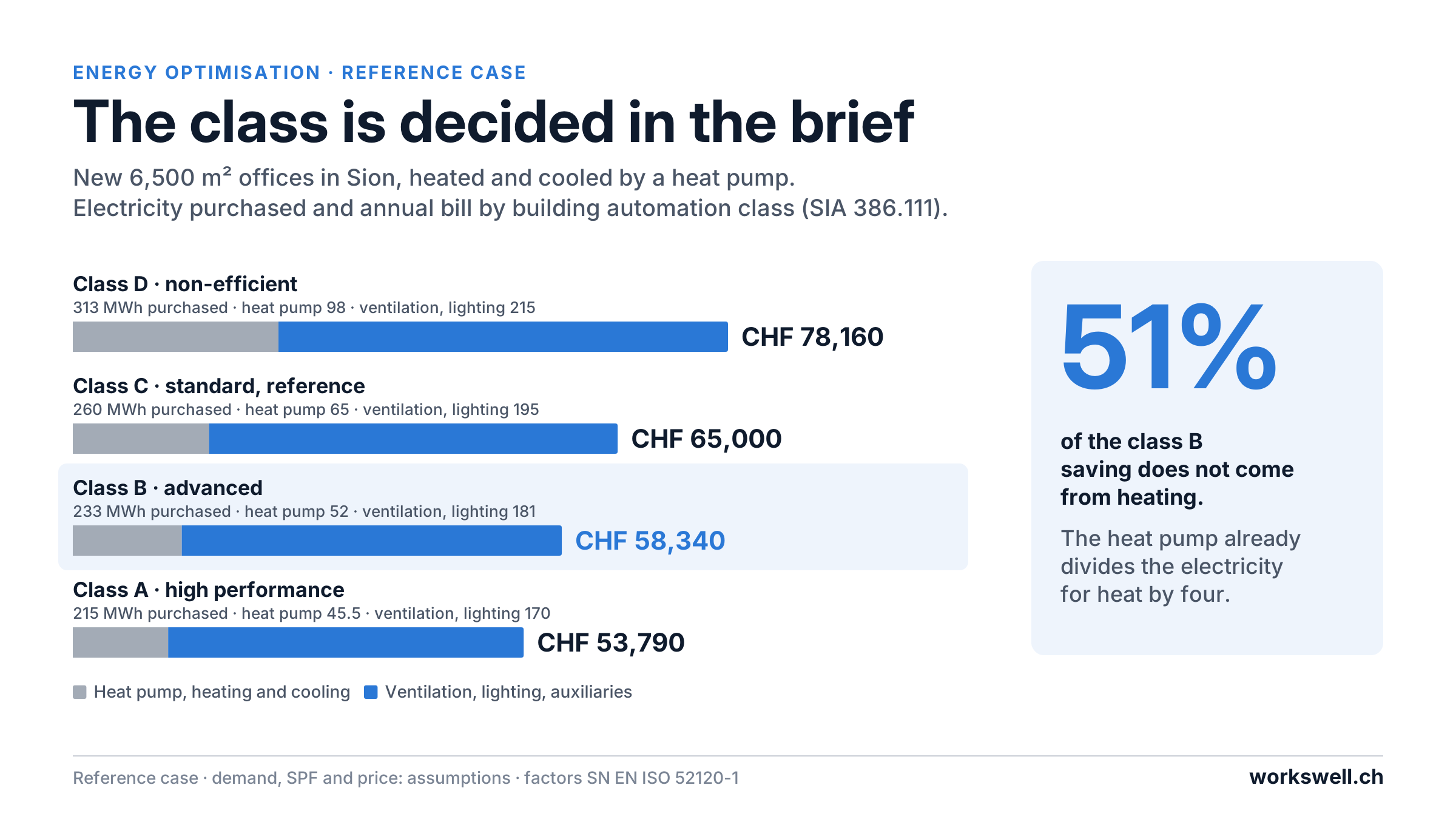
For the same building, the building automation class makes the electricity bill of a new office building in Sion range from CHF 53,790 to 78,160 a year.
This class, defined by SN EN ISO 52120-1 (SIA 386.111), rarely appears in the brief. Yet it is decided at the same time as the façade and the partitioning, because some of the functions it requires depend on architectural choices.
This article puts figures on the standard’s four classes for a typical Swiss project over 15 years. A single axis: operating consumption by class. The capital cost of the building automation system, specific to each project, is left out.
The reference case
A new 6,500 m² office building in Sion, heated and cooled by a heat pump, which buys 260 MWh of electricity a year in class C, or CHF 65,000.
| Parameter | Value |
|---|
| Location and use | Sion (Valais), administration, category III under SIA 380/1 |
| Energy reference area | 6,500 m² |
| Heating and cooling plant | Brine-to-water heat pump on geothermal probes, free cooling (geocooling) in summer |
| Thermal demand in class C (heating, cooling, hot water) | 40 kWh/m²·yr, i.e. 260 MWh |
| Heat pump seasonal performance factor, heating and cooling | 4 on average, i.e. 65 MWh of electricity |
| Ventilation, lighting, auxiliaries in class C | 30 kWh/m²·yr, i.e. 195 MWh |
| Electricity price | CHF 0.25/kWh, 2026 business tariff |
| Horizon | 15 years, constant prices |
The heat pump is not a preference: MuKEn 2025, the cantons’ model energy regulations, requires fully renewable heat in new buildings. The same building also crosses the thresholds for consumption metering (from 2,000 m²), on-site solar generation (20 W/m², i.e. 130 kWp) and, if the canton adopts the relevant module, operational optimisation (from 200 MWh of electricity a year).
Occupants’ plug loads (workstations, kitchens) are left out: the automation class has no effect on them. All values in the table are working assumptions.
The standard’s four classes
The standard assigns each class a factor that multiplies the consumption of class C, the reference. For offices, class B takes 20% off heating and cooling, class A 30%.
| Class | What the controls do | Thermal factor | Electrical factor |
|---|
| D | No efficient control; to be avoided in new buildings | 1.51 | 1.10 |
| C | Standard room control, fixed schedules | 1.00 | 1.00 |
| B | Communicating room controllers, lighting and ventilation by occupancy or daylight, central building management | 0.80 | 0.93 |
| A | Everything driven by actual demand (presence, air quality, daylight, sun), optimised and integrated | 0.70 | 0.87 |
With a heat pump, the thermal factor reduces the heating and cooling produced, and the heat pump’s electricity falls in the same proportion. Applied to the reference case:
- Class B. 260 MWh × 0.80 = 208 MWh thermal, i.e. 52 MWh for the heat pump; 195 MWh × 0.93 = 181 MWh for the rest. 233 MWh purchased, CHF 58,340 a year, CHF 6,660 less than class C.
- Class A. 182 MWh thermal, i.e. 45.5 MWh for the heat pump; 170 MWh for the rest. 215 MWh purchased, CHF 53,790 a year, CHF 11,210 less.
- Class D. 393 MWh thermal, i.e. 98 MWh for the heat pump; 215 MWh for the rest. 313 MWh purchased, CHF 78,160 a year, CHF 13,160 more.
The 15-year balance
Over 15 years, class B saves CHF 99,900 compared with class C, class A CHF 168,150.
| Class | Heat pump (heating and cooling) | Ventilation, lighting, auxiliaries | Electricity purchased | Annual bill | Difference over 15 years |
|---|
| D | 98 MWh | 215 MWh | 313 MWh | CHF 78,160 | + CHF 197,400 |
| C | 65 MWh | 195 MWh | 260 MWh | CHF 65,000 | Reference |
| B | 52 MWh | 181 MWh | 233 MWh | CHF 58,340 | − CHF 99,900 |
| A | 45.5 MWh | 170 MWh | 215 MWh | CHF 53,790 | − CHF 168,150 |
Another reading, more useful at brief stage: over 10 years, the class B saving pays for CHF 66,600 of additional controls, the class A saving for CHF 112,100. That is the budget to compare with the actual extra cost of the building automation system, priced project by project.
What is surprising
In a new building heated by a heat pump, more than half of the saving does not come from heating. The heat pump already divides the electricity needed for heat by four: the class B gain there shrinks to 13 MWh, against 14 MWh on ventilation, lighting and auxiliaries. In class A, this non-thermal share rises to 57%.
For the architect, this shifts the focus. Lighting by presence and daylight, ventilation by occupancy, blinds by sun position weigh at least as much as heating control. And these functions depend on the plan: lighting zoned along the façade, presence detection per room, motorised solar shading.
Class B covers 59% of the way. Going from B to A adds only CHF 4,550 a year: that step must cost less than CHF 45,500 to pay back in 10 years.
The real risk remains losing class B without knowing it. The class is measured by the functions actually active: schedules forced to permanent comfort, presence detection bypassed, blinds switched back to manual, and the building is class C again. The bill rises by 11%, without any alarm reporting it.
What corrects the calculation
- The factors are averages. The standard presents them as a first estimate for a building type. On a real project, a detailed calculation or a measurement is still needed.
- The price per kWh depends on the contract. At 260 MWh a year, the building can buy its electricity on the open market, which is accessible from 100 MWh. Between CHF 0.20 and 0.30/kWh, the annual class B saving ranges from CHF 5,330 to 8,000. The MWh do not change.
- Solar changes the value of a saved kWh. In the hours when the required 130 kWp produce more than the building consumes, a saved kWh is no longer bought but fed into the grid, at the lower feed-in tariff. The saving in francs is therefore slightly lower than calculated.
- The class is assessed domain by domain. A building whose lighting is still switched by hand does not reach class B for lighting, however good its heating control.
- Classes B and A require communicating controllers. On an open, documented protocol, any qualified company can maintain their functions. On a closed system, every setting depends on a single integrator.
What is decided at preliminary design
Four decisions, taken before the tender (SIA phases 31 and 32), set the class the building will be able to reach and keep.
- Write the target class into the brief, under SN EN ISO 52120-1 (SIA 386.111), domain by domain: heating, cooling, ventilation, lighting, blinds.
- Check that the design allows it: motorised solar shading, lighting zoned by daylight, window contacts, presence detection per room.
- Translate the class into a list of functions in the BMS specification, from the standard’s catalogue, then check it function by function at handover.
- Plan the metering that will show, year after year, that the class is still there (see energy monitoring).
The Swiss framework points the same way. MuKEn 2014, adopted by almost every canton, already required consumption metering and display in new non-residential buildings from 5,000 m² of energy reference area. MuKEn 2025, which the cantons are transposing by 2030, lowers this threshold to 2,000 m² (art. 1.23); its optional module 14 adds demand-controlled regulation. Neither edition sets a class: that choice remains with the building owner and its consultants.
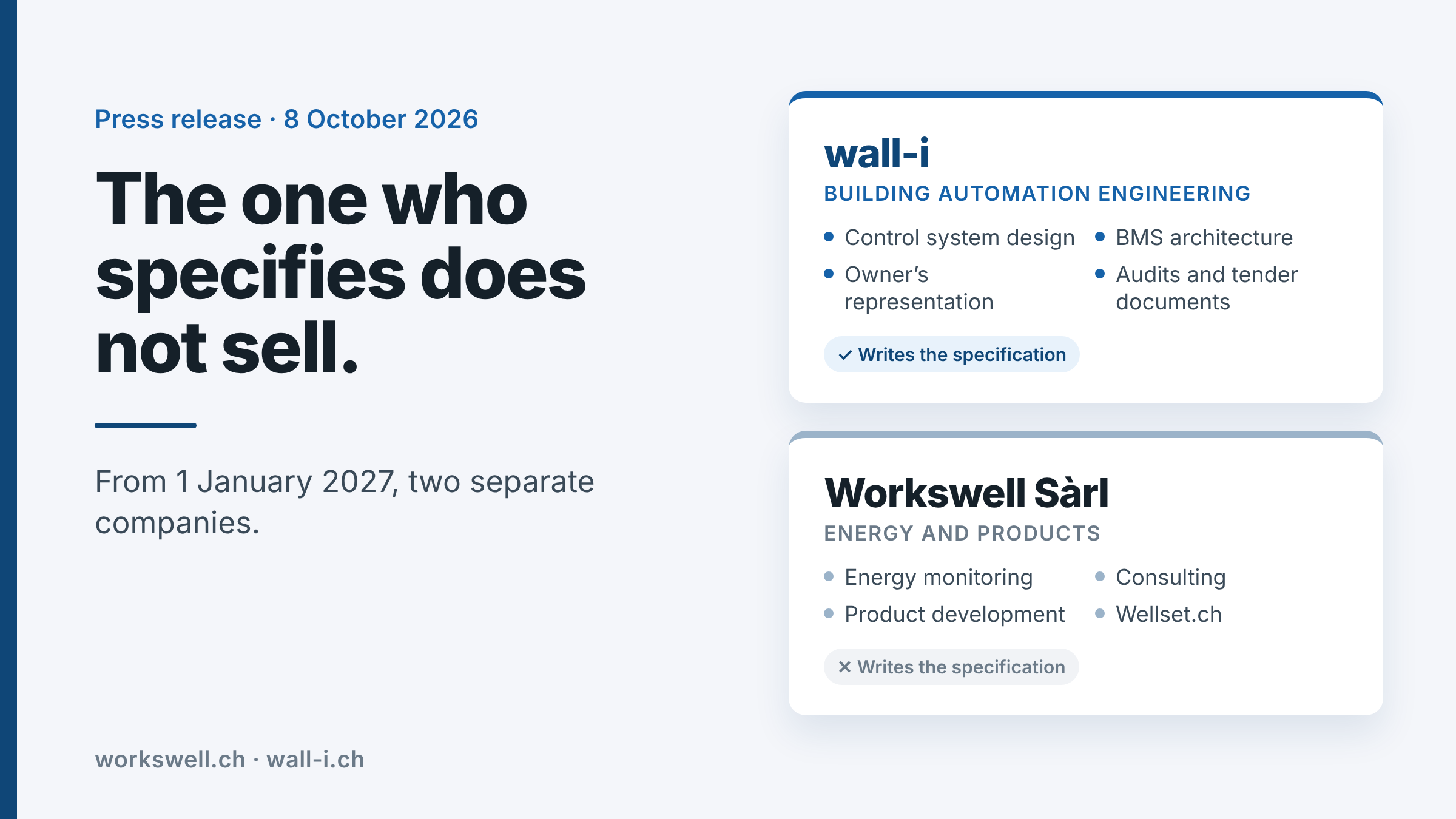
Until the end of 2026, Workswell also writes BMS specifications, and a higher class lengthens their list of functions: read this calculation with that caveat. It still concludes that class B covers most of the way. Redo it with your own figures.
From 1 January 2027, writing MCR/BMS specifications (point 3) is handled by wall-i, a separate company. Metering (point 4) stays with Workswell.
Frequently asked questions
What is a building’s automation class?
SN EN ISO 52120-1 (SIA 386.111) groups control and building management functions into four classes, from D (non-efficient) to A (high performance). Class C is the reference. Each class corresponds to a level of function per domain: heating, cooling, ventilation, lighting, blinds.
Which class should new offices aim for?
In the reference case, class B delivers 59% of the class A saving. It is the right starting point. Class A is justified if its extra cost over B stays below CHF 45,500, i.e. ten years of additional saving.
Does the law require an automation class?
No. MuKEn requires consumption metering in new non-residential buildings (from 5,000 m² in the 2014 edition, from 2,000 m² in the 2025 edition) and, in its optional module 14, demand-controlled regulation. No edition sets a class.